How to start
- Open bigboard.games on every device and tap Start a table on one of them.
- The others join by themselves on the same Wi-Fi; elsewhere, scan the QR code or type the four-letter code.
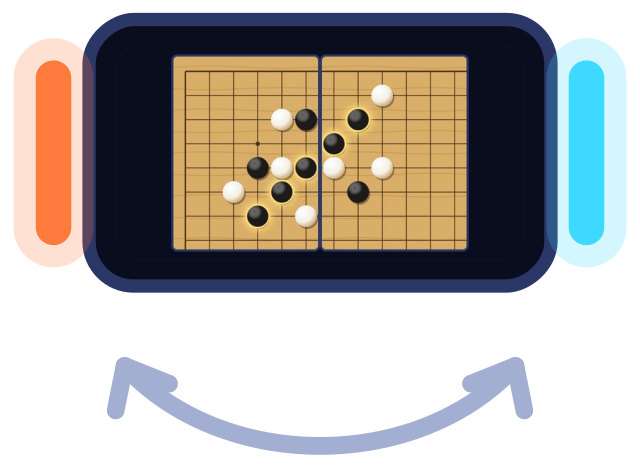
- Lay the devices edge to edge, screens up, as the drawing shows, and pick the game.
Your own screen, one shared board
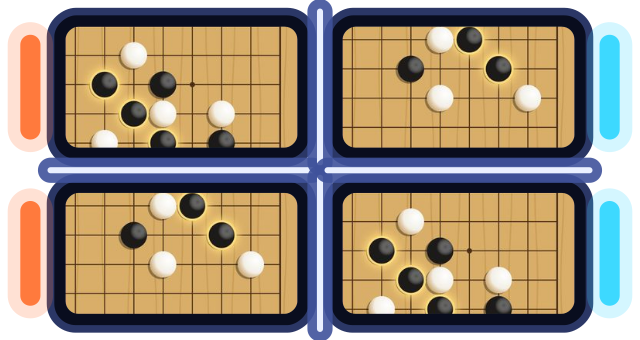
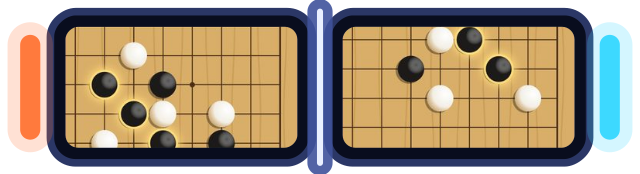
Start a table on one phone, open the same address on the second and pick Go & Gomoku, then Gomoku in the Game row. By default each phone shows the whole board, the stones in a wooden pot beside it. Switch on One big board and lay the phones together: each holds its own part of the board, and the grid runs on across the gap as if the edges weren't there.
One big board needs phones big enough for the board size; when they aren't, each shows the whole board, and the lobby says which before the match starts. On the whole board two fingers zoom and scroll 19 × 19, one finger places a stone. The same two phones play the other games for two on separate phones too.
A move, a block, a five
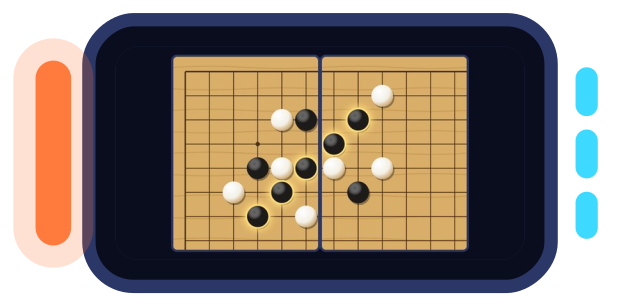
Tap a point to see a ghost stone there, tap again to place it, or drag a stone out of your pot and let go over the point. Whoever is to move gets a glow round the edge of their own phone, so you always know whose turn it is without looking at the other screen.
The game is a race: build lines of your own while you block your friend's. An open three, three in a row with both ends free, must be answered at once, or it becomes an open four and nothing can stop it. The moment either of you has five in a row, the line lights up in the winner's colour and the match ends. The Gomoku article tells the game's long history, and the rules of Gomoku fit on one page.
Rules, a friend far away, a rematch
Freestyle, the default, lets six or more in a row win too; Standard counts exactly five; Renju forbids Black a double three, a double four and an overline, and the board refuses such a point with a note saying why. A move timer keeps a quick game quick if you want one.
If your friend isn't in the room, they join with the table's link or code and play on the whole board on their own phone. Black moves first, and the next match hands Black to the other player. Only one phone between you? Gomoku for two on one phone needs a single screen; playing alone, try Gomoku against the computer.
2 players: questions and answers
Can two phones make one Gomoku board?
Yes, switch on One big board and lay them together; if the phones are too small for the board size, each shows the whole board instead.
Can a friend play Gomoku with me from another place?
Yes, they join with the table's link or code, and both phones show the whole board.
Who moves first?
Black. The first move goes to the other player in each new match, so it evens out over a session.
Are there captures in Gomoku?
No, stones stay where they are put; the only goal is five in a row.